My Nighttime Routine That Actually Helps Me Sleep (+ Why I Take It So Seriously)
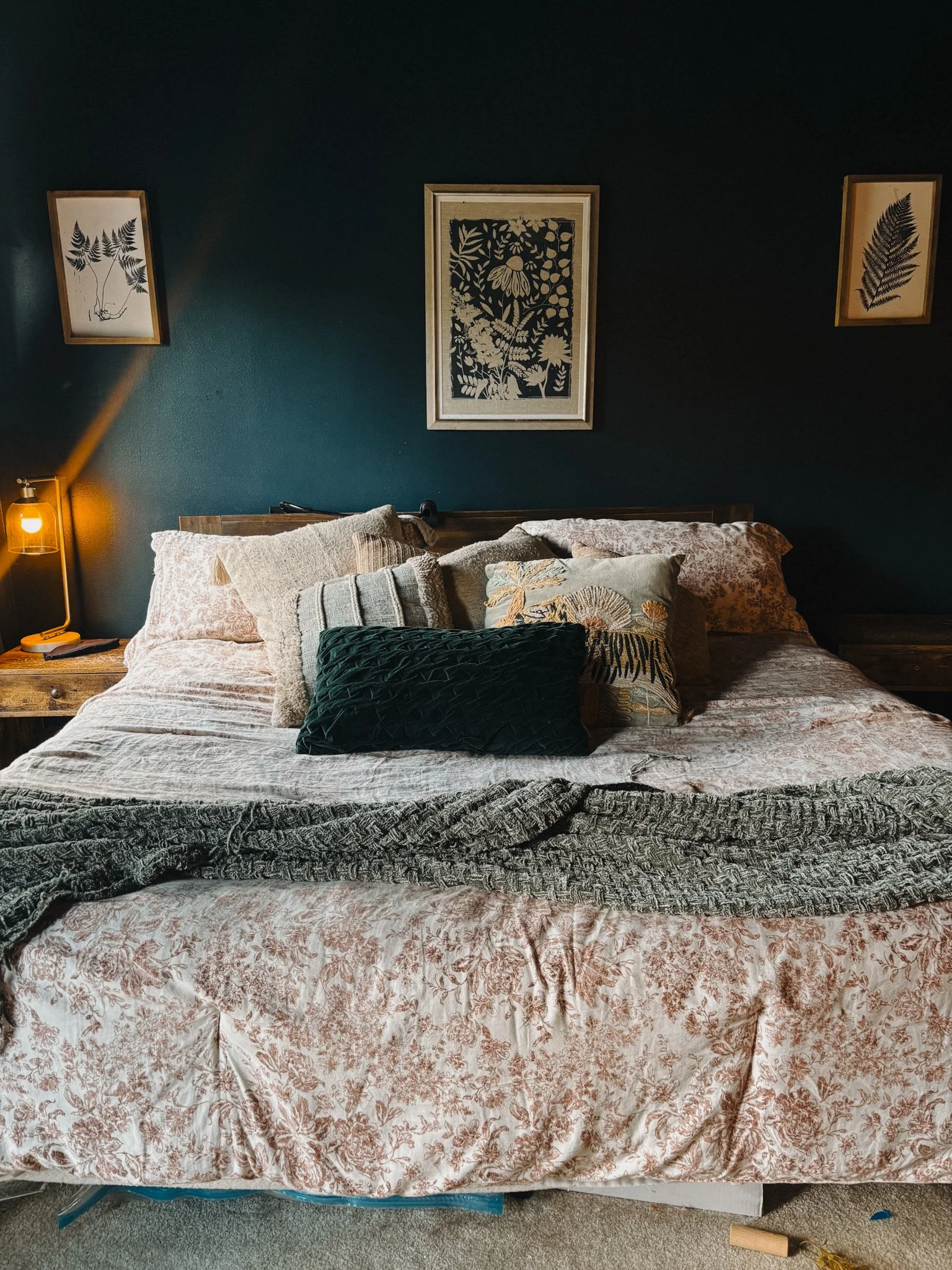
Yesterday I asked you guys on Instagram how many pillows you have on your bed (including decorative throw pillows) + how many you actually sleep with.
Random? Not really.
Hawthorne is in his counting era, so we count everything. Orange slices in his little wine glass, essential oil bottles on the counter, + the pillows on my bed. Which he immediately throws off one by one right after I make it.
For the record, I have 13 pillows. My husband + I sleep with two each, I use a third as a body pillow, + the rest are decorative.
Is that excessive? Maybe.
But I grew up in a home where everything was always beautifully put together. Clean, intentional, almost like a model home. + while it didn’t always feel “lived in,” it did feel peaceful, elevated, + calm. I loved it then and I still love it now.
So I carried that into my own home. Especially my bedroom. I’ll blame it on my moon in Libra.
Because to me, your bed sets the tone. It is usually the first thing your eye goes to when you walk in + a fully made, layered, inviting bed just feels better. It adds softness, warmth, + luxury to your everyday life.
But what started as a conversation about pillows quickly turned into something else in my DMs.
Sleep.
Your routines, what helps, what doesn’t, the little things that make a difference.
And as someone who has built a very intentional nighttime routine, I asked if you wanted a peek.
You said yes. So here we are.
Why I Care So Much About Sleep
After I had Hawthorne in 2022, I started walking. A lot.
Twice a day, usually totaling 4 to 5 miles. It was for my mental health, for reconnecting with my body, + honestly just for enjoying the beauty of the historic district I lived in and the beautiful fruit trees and tropical flowers that bloomed in that beach town.
+ on those walks, I listened to podcasts nonstop. One of my favorites at the time was The Him and Her Podcast (now called The Bossticks), where I was first introduced to things like biohacking, hormone health, + sleep optimization.
+ the more I learned, the more I realized something very simple:
Everything comes back to sleep (+ gut health).
Sleep affects:
your mood + emotional regulation
your hormones + metabolism
your immune system
your skin + physical recovery
your focus, creativity, + mental clarity
When your sleep is off, everything feels harder. When your sleep is dialed in, everything feels more manageable. I’ve always been high maintenance about my sleep which used to be a source of shame because my mom can stay up ALL night working on projects or… work. But even since middle school I recall never being able to stay up late even if I had homework to finish. I HAD to give up and head to bed. My brain simply no longer worked + my body refused to stay up.
So instead of trying to fix everything else first, I focused on this.
How My Nighttime Routine Actually Started
When Hawthorne was still a newb, he would go to bed around 7.
+ what was I going to do after that?
I wanted to be near him in our bed as we coslept +, later, as he was in his bedside bassinet. I wanted to be home. So instead of filling that time with TV or scrolling, I started building a routine that supported me + my instinctual need to be near my freshly born child.
Over time, it became something I genuinely look forward to.
My Ideal Nighttime Routine
This is what I do on an ideal day. Not every single day looks like this, but this is the rhythm I come back to again + again.
Morning sets the tone
Before we even get to nighttime, this matters.
As soon as I wake up, I step outside + get sunlight in my eyes for about 10 minutes. No sunglasses. No phone. + no, I’m not staring at the sun. But just being outside, eyes open, is all you need.
This helps regulate your circadian rhythm, which is your body’s internal clock. It signals wakefulness in the morning + helps your body naturally wind down at night.
It is one of the simplest things you can do for better sleep.
Two hours before bed, everything shifts
Around 7pm, I start transitioning.
Overhead lights go off
Lamps only
No TV
Phone goes away
Blue light has a time + place. During the day, it keeps you alert + focused. At night, it does the opposite of what you want: it tells your brain to stay awake.
So I remove it.
My space gets darker, quieter, softer.
Setting the environment
My bedroom is dark. My diffuser is going with my fave sleep blend.
I keep just a few low lights on:
Everything is designed to tell my body, “we are winding down now.”
The bath
This is my favorite part.
I take a hot bath with Epsom salts + essential oils. Lights low. Kindle on the dimmest setting.
I stay in for about 10 minutes, just until I start to sweat.
This helps my body fully relax, muscles soften, nervous system calm down. It makes that transition into sleep feel soooo much easier.
The cold shower
Right after the bath, I take a quick cold shower.
Not for anything extreme. Just enough to bring my body temperature back down so I am not getting into bed overheated.
It resets everything and makes getting into bed feel incredibly comfortable.
Skincare and wind down
I do my skincare in low light, then move straight into my dark bedroom.
No bright lights, stimulation, or distractions.
Just a seamless transition into rest.
In bed
I get into bed, grab my Kindle, + read until I fall asleep.
That’s it.
No scrolling or mental overload. Just something calm + low effort that helps me drift off naturally. + now that I say this, I think all of the steps I do before this really do help turn my brain off; the anxious thoughts from my day, the to-do lists, the ruminating all starts to quiet during these two hours so I’m not wired + awake thinking about an embarrassing memory from earlier in the day.
A Few Things I Used to Do (+ Why I Don’t Anymore)
I used to drink a “sleepy girl mocktail” with added magnesium, but now I drink Ningxia throughout the day + don’t feel like I need the added magnesium anymore.
I also used to go on long evening walks before starting my routine, which helped a lot with lowering cortisol. I would absolutely still do this if I had the same walking paths.
But even without those things, this routine works.
What I’ve Noticed Since Committing to This
I fall asleep easily.
I stay asleep.
I wake up feeling clear + energized, not groggy.
I feel more regulated overall.
This routine is is about giving my body consistency, safety, + support.
The Biggest Takeaway
If you take nothing else from this, take this:
Put your phone down two hours before bed.
You do not need to overhaul your entire life overnight. Just start there.
Sometimes it’s not about doing more but about removing the one thing that is disrupting everything.
