Why Do Spiritual People Track the Moon?
The History Behind One of the World's Oldest Spiritual Practices
If you've spent any amount of time in the spiritual community (or following me on social media), you've probably noticed people getting veeeerrrry excited about the full moon or reminding everyone that a new moon is coming.
Maybe you've seen someone charging crystals under the moonlight, burning pieces of paper with things the want to energetically release, making moon water, journaling their intentions, or talking about "full moon energy."
From the outside, it can TOTALLY seem like one of those trendy Instagram wellness habits which I TOTALLY get.
But believe it or not, this didn't start on Instagram (+ if you’re reading this that means you PROBABLY follow me so you PROBABLY knew this already but hey if you’re new, welcome!).
Humans have been tracking the moon for thousands of years, making it one of the oldest traditions we still practice today which imo makes it THAT much sweeter.
The Moon Was Humanity's First Calendar
Long before smartphones, planners, clocks, or written calendars existed, people looked up because the moon became one of humanity's earliest ways of measuring time.
Unlike the sun, which rises and sets every day in a relatively predictable way, the moon changes constantly. Every month it disappears, slowly returns, reaches fullness, then begins to wane again in an incredibly reliable rhythm.
Ancient civilizations noticed this pattern very early.
The Babylonians used lunar observations to create some of the earliest calendars. Ancient Egyptians tracked lunar phases alongside the flooding of the Nile. The Greeks connected lunar cycles to festivals honoring their gods + goddesses. Traditional Chinese calendars have followed lunar cycles for thousands of years, + many holidays, including Lunar New Year + the Mid-Autumn Festival, are still determined by the moon today.
Also the date of Easter is determined by the first full moon of spring. hehehehe
Indigenous cultures around the world also named each full moon based on what was happening in nature at that particular time of year.
That's where names like the Wolf Moon, Pink Moon, Strawberry Moon, Buck Moon, + Harvest Moon come from.
The moon wasn't just something beautiful to look at; it lit-trally helped people organize life.
The Moon Helped People Survive
Tracking the moon wasn't originally spiritual, it was practical.
Farmers noticed that certain planting + harvesting tasks seemed to align well with different lunar phases. While modern agriculture relies more heavily on soil conditions, weather, + climate, many gardeners still practice lunar gardening today, believing different moon phases support different types of plant growth.
Fishermen learned that the moon influences ocean tides through its gravitational pull, helping predict the best times to fish (+ as a daughter of a sports fisherman I acn tell you full moons are VERY important).
Hunters paid attention to brighter full moon nights because visibility changed animal behavior.
Entire communities planned gatherings, celebrations, + ceremonies around the full moon because before electricity, extra moonlight made it easier to travel safely after dark.
Imagine living thousands of years ago with no streetlights, flashlights, or porchlights.
A bright full moon gave people that light which meant more hours to work, celebrate, tell stories, visit neighbors, + connect with their community.
The moon literally shaped daily life.
So... Is There Actually Science Behind It?
This is where things get interesting.
One of the biggest misconceptions is that science completely dismisses humanity's relationship with the moon.
It doesn't.
We know the moon's gravity is powerful enough to move entire oceans, creating the tides that shape our coastlines every single day.
Some researchers have also explored whether lunar cycles influence sleep quality, nighttime activity, wildlife behavior, + reproductive patterns in certain species. While the evidence for direct effects on human emotions is mixed + still debated, the moon clearly affects life on Earth in measurable ways.
Tbh if you are or have ever been a nurse or teacher, you’re probably on the side of “THE MOON DEFINITELY AFFECTS HUMANS!!!”
BUT
You don't have to believe the moon is energetically changing your mood for this practice to have value.
Because there's another piece of science that's much less controversial.
The Psychology of Ritual
Humans thrive on rhythm.
Research consistently shows that intentional rituals can help reduce stress, increase mindfulness, improve emotional regulation, + create a greater sense of meaning.
Think about it: we celebrate birthdays every year, make New Year's resolutions every January, many religious traditions gather weekly, athletes have pregame rituals, families have holiday traditions, etc. etc. etc.
These rhythms help us slow down long enough to notice our lives.
Working with the moon functions in much the same way.
Instead of letting the months blur together, the lunar cycle gives you built in checkpoints to pause, reflect, + reset.
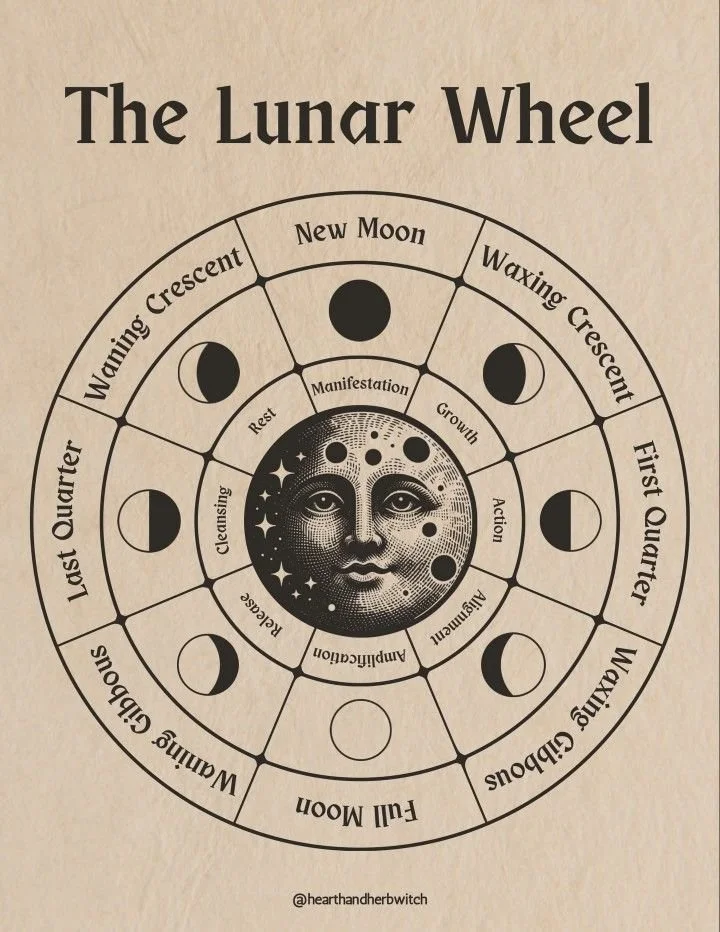
Why the New Moon Feels Like a Fresh Start
Spiritually, the new moon has become associated with beginnings.
During this phase, the moon is hidden from view, creating a symbolic blank slate.
Many people use this time to ask themselves:
What do I want to create?
What deserves more of my attention?
What habits do I want to build?
What am I ready to begin?
You'll often see people journaling, making vision boards, meditating, pulling tarot cards, setting goals, or creating manifestation lists during the new moon.
Whether you're planting seeds in a garden or planting ideas for your future, the symbolism is the same.
Why the Full Moon Is Associated With Letting Go
About two weeks later comes the full moon.
This is when the moon is fully illuminated, making it one of the brightest objects in the night sky.
Spiritually, that illumination has become a symbol of awareness.
Things become visible, emotions feel harder to ignore, + patterns become easier to recognize.
Many people use the full moon to ask themselves:
What's working?
What isn't?
What have I outgrown?
What am I ready to release?
This is why you'll often hear about people writing down limiting beliefs before safely burning the paper, taking cleansing baths, meditating, decluttering their homes, or simply spending time reflecting under the moonlight.
The ritual itself isn't magic but the awareness it creates can be.
Why I Love Working With Moon Cycles
One of my favorite things about working with the moon has nothing to do with predicting the future.
It reminds me to stop (even if it’s just for moments) because life moves fast.
For this Type A/eldest daughter/only child/Virgo sun/Cap rising there is always another email, another load of laundry (my fave chore), another project, another goal, + another thing to check off of the to do list.
The moon gently interrupts that cycle twice every month.
It asks you to check in with yourself before another month slips by.
Maybe you're celebrating how far you've come or you're grieving something you're ready to let go of or you're simply sitting outside for five quiet minutes because you haven't done that in weeks.
None of those moments are wasted because they're how we build a more intentional life.
The Big Takeaway
The moon doesn't have to control your life for it to become a meaningful part of it.
Whether you see the lunar cycle as spiritually significant, psychologically grounding, or just a beautiful excuse to pause twice a month, you're participating in something humans have been doing for thousands of years.
Long before planners, productivity apps, social media told us to optimize every second of the day, people looked up + they noticed the moon.
They allowed its steady rhythm to remind them that life naturally moves in cycles.
The lesson here is not that the moon changes us, but that it reminds us to keep checking in as we change ourselves.
Muah muah muah!
Suzy
