Why Do Woowoo Besties Sleep With Amethyst Under Their Pillow?
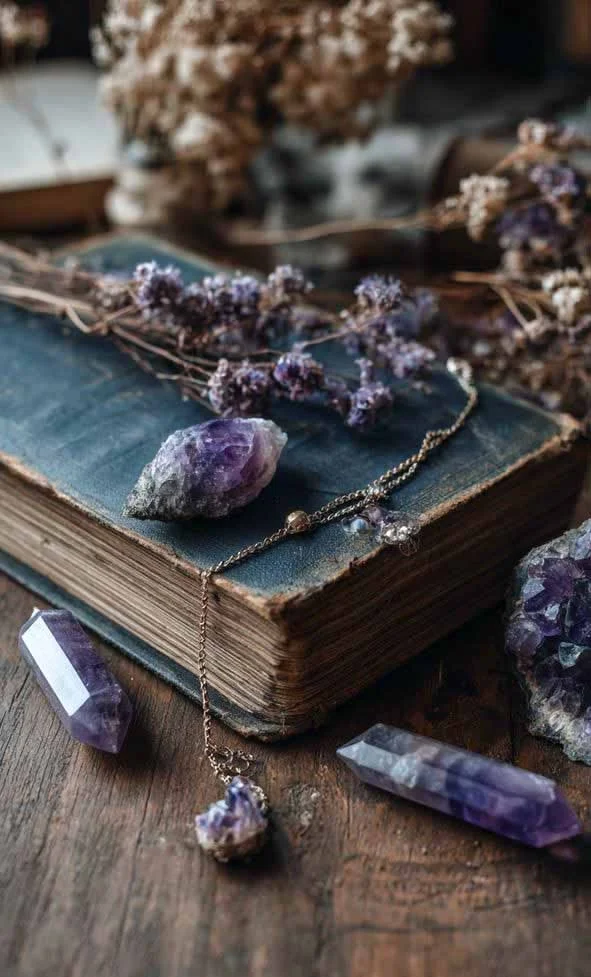
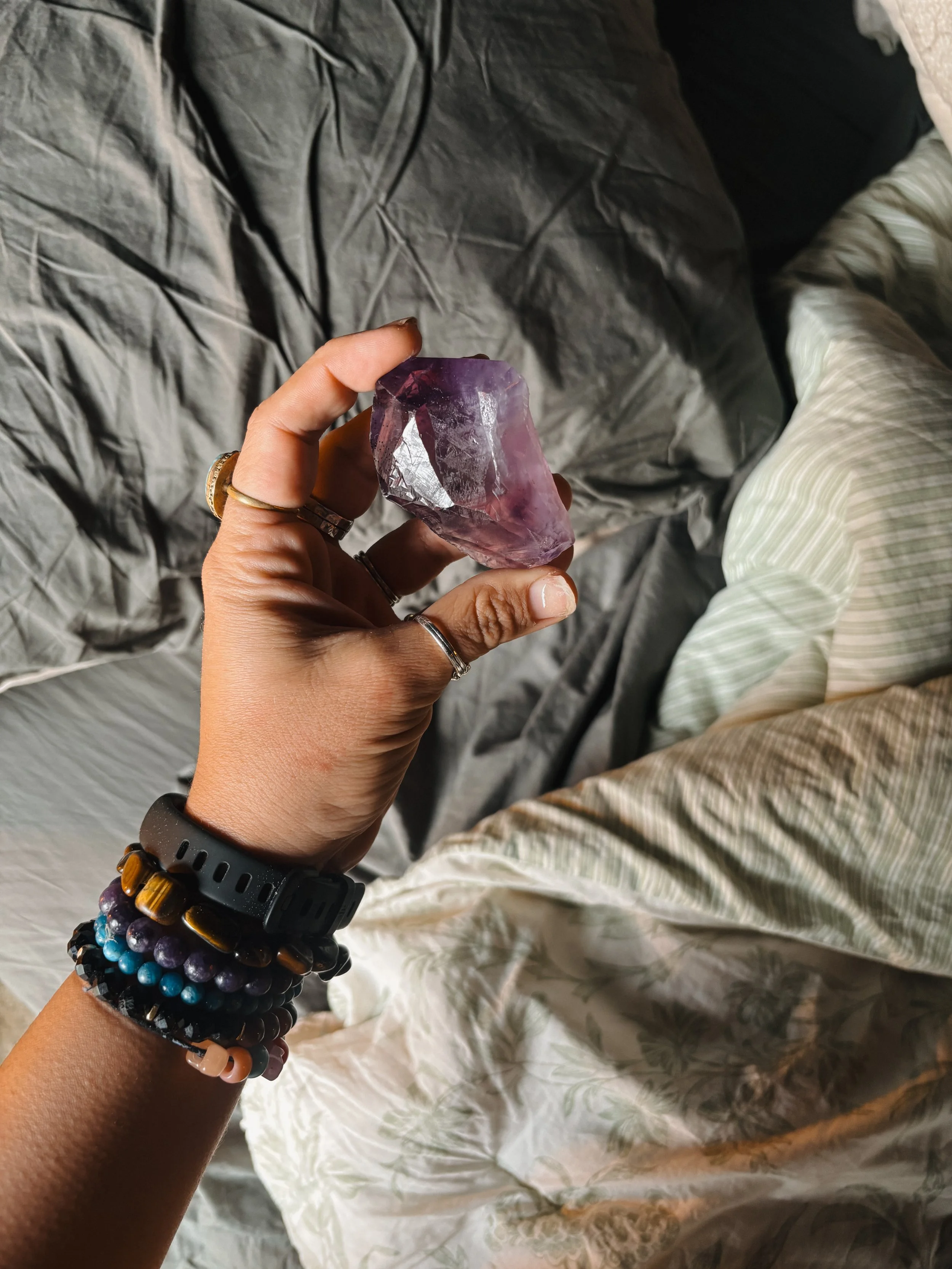
Before you begin: links to my fave crystal shops AND discount codes at the bottom if you don’t have amethyst yet but want to grab one after reading!
This is the kind of woowoo practice that sounds like something a teenager on Pinterest invented in 2017… or maybe before that… or after??? My eyes started opening to how rapidly people were leaning into spirituality around the time that I began my own journey in 2017 so who knows?!
Put a purple rock under your pillow + apparently your dreams will be better, your intuition will be stronger, your nervous system will calm down, + maaaaybe the universe will finally answer that text you’ve been waiting on.
Except…
Humans have been assigning some pretty wild powers to amethyst for a v long time.
The specific practice of sleeping with amethyst under your pillow SPECIFICALLY is difficult to trace to one ancient culture or exact historical tradition. But the idea behind it is much, much older: humans have been carrying, wearing, placing, + sleeping near objects they believed could protect them, influence their dreams, calm their minds, or connect them with something beyond the physical world for thousands of years.
+ amethyst has been one of those special objects for a veryyy long time.
What even is amethyst?
Amethyst is the purple variety of quartz, + its color comes from tiny amounts of iron and other elements within the crystal structure.
Today, you can find amethyst pretty easily + relatively inexpensively, but that wasn't always the case.
For much of history, amethyst was considered a precious + highly desirable gemstone. Ancient Egyptian records + archaeological finds show that amethyst was used for beads, jewelry, amulets, + scarabs as far back as the early dynastic periods.
So this wasn't some random purple rock humans decided looked mystical. People have been looking at this particular stone for thousands of years + thinking, there's JUST something about this.
The Greeks thought amethyst could keep you from getting drunk
This is probably the most famous piece of amethyst folklore, + honestly, it's pretty quirky.
The Greek word amethystos is generally translated as "not drunken" or "not intoxicated." Ancient Greek + later Roman traditions associated the stone with protection from drunkenness.
The belief was so strong that amethyst became associated with drinking culture itself. I’ve even heard of individuals placing amethyst in their medicine cabinets next to any mental health medications.
Ancient writers mention amethyst in connection with wine, + Roman author Pliny the Elder recorded claims that the stone could prevent intoxication. He was actually pretty skeptical of the magical claims surrounding it, which makes his account even more interesting.
In other words, ancient people weren't necessarily looking at amethyst and thinking, "This is my sleep crystal."
They were thinking something more like:
"This purple stone has the power to keep me from losing control."
+that theme of sobriety, restraint, clarity, + protection would follow amethyst for centuries.
I do NOT recommend going on an afternoon drinking binge with amethyst in your pocket and hoping you won’t wake up with a bangin’ hangover, however.
Then things get even more woowoo
Here's where I really fell down the amethyst rabbit hole: ancient sources didn't associate amethyst with only sobriety.
Pliny records a whole collection of magical claims surrounding the stone, including protection from spells. Other ancient references connect amethyst with love + magical practices. One surviving ancient engraved amethyst, for example, was associated with Hermes (where are my Greek mythology nerds at?!?!?!) + may have been intended as a love charm (but like… we know how Hermes was. Why wasn’t this associated with Aphrodite? Whatever).
So amethyst was not simply a "calm down" stone.
It had a much broader reputation as aprotective, spiritual, magical object.
+ that matters when we eventually get to the pillow.
Why???
Because what is your pillow? It's where you put your head, enter the dream state, are unconscious, vulnerable, + completely removed from the normal stimulation of your day.
If you're someone who believes objects can hold symbolism or spiritual meaning, placing a stone associated with protection + clarity beside your head while you sleep makes a surprising amount of cultural sense.
Ancient Egyptians were big on magical objects, too
Amethyst also has a long history in ancient Egypt.
The Egyptians used amethyst for jewelry + amulets, + amulets were not simply decorative accessories; they were objects believed to carry protective or beneficial powers.
The Metropolitan Museum of Art explains that Egyptian amulets could derive their meaning from their shape, material, color, inscriptions, spoken words, or rituals performed over them. They were often worn directly against the body because proximity mattered.
+ this is one of the oldest ideas hiding underneath modern crystal practices:
The object doesn't just sit somewhere. You put it somewhere meaningful.
Against your body, around your neck, inside your clothing, beside you, with the dead, near the places where you were considered vulnerable, etc.
So while we can't honestly say, "Ancient Egyptians slept with amethyst under their pillows," we can say that the practice of using meaningful stones as protective objects + keeping them physically close to the body is extremely old.
Amethyst eventually became a spiritual stone in Christianity, too (SHOCKER but not so much)
As amethyst moved through European history, its symbolism shifted + expanded.
The stone became particularly associated with Christian clergy. Archaeological evidence from medieval Scotland, for example, includes rings set with amethysts among people buried in medieval contexts.
Its rich purple color also made it particularly appropriate for religious + royal symbolism.
Purple has long carried associations with spirituality, authority, + status, so amethyst became a natural fit for religious jewelry + ceremonial objects.
THEN the Victorians gave amethyst another meaning: mourning
This is one of my favorite pieces of amethyst history.
During the Victorian era, jewelry became deeply intertwined with grief, remembrance, + mourning. Queen Victoria's prolonged mourning after the death of Prince Albert helped popularize (kinda feels like the wrong word to put here but you know my heart!) mourning jewelry throughout society.
+ amethyst found a particularly interesting place in half-mourning, the transitional period when a person was beginning to move out of the deepest stage of grief.
Purple, mauve, lavender, + other subdued colors were appropriate during this stage, making amethyst a natural choice for mourning + memorial jewelry.
Think about the symbolism there:
A stone that had already accumulated associations with sobriety, protection, spirituality, + emotional restraint became part of jewelry worn while people were moving through grief.
Amethyst became connected not just with spirituality, but with transition.
With moving through something, or carrying something painful while slowly returning to life.
tbh?
That makes the modern association with nighttime rituals feel even more interesting.
So when did amethyst become a "sleep crystal"?
This is where we have to separate documented history from modern crystal culture.
There isn't good evidence that ancient Greeks had a standardized ritual of putting amethyst under their pillows for sleep + that's important because the internet loooooves to turn a modern practice into an "ancient ritual" with no receipts.
What we do have is a much older collection of beliefs surrounding amethyst:
Protection, sobriety, clarity, spirituality, dreams, transition, + keeping meaningful objects close to the body.
There are even ancient traditions in which particular stones were believed to influence dreams. Pliny (the accidental star of this blog post), for example, records a different stone called eumeces that was said to produce prophetic dreams when placed beneath the head like a pillow… HOW DO I GET MY HANDS ON THAT?
A pretty fascinating reminder that the basic concept of "put a special stone near your head while you sleep because it may affect your dreams" is, in fact, very old.
Okay, but does amethyst actually help you sleep?
Here's where the woowoo meets the science.
There is currently no good scientific evidence that sleeping with amethyst under your pillow directly improves sleep, changes your brainwaves, balances your energy, or causes particular dreams. Fine, fine, no surprise there. Research specifically on crystals and sleep is extremely limited.
A 2025 randomized controlled study looking at crystal healing found that people who believed in crystal healing reported improvements regardless of whether they received the actual crystal or a visually similar placebo. The researchers concluded that the effects were better explained by expectancy and placebo mechanisms than by a specific effect of the crystal itself.
But I don't think that makes the ritual pointless, actually, I think it makes the ritual more interesting. Because guess what? The placebo effect also MEANS something. When you BELIEVE, the effects manifest themselves. There’s obviously nuance to this please don’t come for me, but I hope you get it.
Your brain is incredibly responsive to meaning, repetition, association, + ritual.
If you pick up your amethyst every night, turn off your phone, take a few deep breaths, journal, set an intention, + then place the stone beside your pillow, you're creating a repeated signal:
✨The day is over.
✨I am safe to slow down.
✨I don't need to solve everything tonight.
✨I can let my mind wander.
The crystal doesn't have to emit some scientifically measurable sleep frequency for that ritual to be meaningful.
The stone can become an anchor + that still counts.
There's something else I love about putting it under your pillow
Your pillow is one of the few places in your house that is completely associated with unconsciousness.
You HOPEFULLY aren't working or answering emails while propped up against your pillow but like no judgment.
You're not cleaning or performing or taking care of everyone else.
You're literally lying down.
So when you put something under your pillow intentionally, you're taking an object that already carries thousands of years of symbolism + giving it a very specific job:
hold the intention while I rest.
Maybe your intention is better dreams, protection, intuition.
Maybe you're trying to stop obsessing over something you can't control, you want to wake up remembering your dreams, or you just want your bedroom to feel more peaceful.
I think that's where modern crystal rituals get really beautiful.
You don't have to believe that amethyst is secretly sending messages to your subconscious. You can believe that you are creating a ritual that gives your subconscious permission to speak.
Try the modern version
If you want to experiment with the practice, keep it incredibly simple. I do advocate for practical spirituality after all!
Before bed, hold your amethyst for a few seconds, take a breath+ ask yourself one question:
"What am I ready to understand?" or "What am I ready to release?" or "What does my intuition want me to notice?"
Then put the amethyst under your pillow or beside your bed + go to sleep.
Don't force an answer or sit there trying to decode every dream.
Just sleep. When you wake up, write down whatever you remember before checking your phone.
A dream, feeling, color, person, completely nonsensical scene involving your third-grade teacher and a goat, or whatever. ANYTHING!
The point isn't necessarily that the amethyst caused the dream.
The point is that you created a little doorway between your waking mind + your inner world, + you gave yourself permission to pay attention.
Humans have been doing versions of that for a very, very long time.
So... why do woowoo besties sleep with amethyst under their pillow?
Because amethyst has accumulated an absolutely ridiculous amount of symbolism over thousands of years + modern spiritual communities have come to associate it with intuition, dreams, peace, protection, + spiritual awareness.
The pillow ritual is not an unbroken ancient tradition.
It's something newer built from older ideas.
Which is actually more interesting.
Humans have always taken objects from the natural world and given them meaning.
We don't have to pretend the science says more than it does + we also don't have to pretend the ritual means nothing.
Sometimes the most interesting part of a woowoo practice isn't whether the object has magical powers, it's why humans have wanted to believe it does for thousands of years.
Get your amethyst!!!
Wild Alabaster: Code WOOWOO15
Meadow’s Crystals: Code SUZY15
